
The way people interact with search engines has undergone a profound transformation. Gone are the days when most queries were short, abrupt, and transactional. Today, thanks to the widespread adoption of voice assistants like Siri, Alexa, and Google Assistant, users are increasingly employing natural language to find information. This fundamental shift has given rise to the critical importance of conversational keywords in modern SEO strategies. Understanding and optimizing for these longer, question-based phrases is no longer optional; it’s essential for staying visible in an evolving digital landscape.

Understanding Conversational Keywords
What exactly are conversational keywords? Simply put, they are the phrases and questions people speak into their devices when performing a voice search. Unlike traditional typed keywords, which might be “best coffee maker,” a conversational query would sound more like, “What’s the best coffee maker for a small kitchen?” or “Where can I buy a highly-rated espresso machine nearby?” They mirror human speech patterns, complete with prepositions, pronouns, and a natural flow.
What Makes Them Different?
- Length and Specificity: Conversational keywords are typically longer, often comprising three or more words, making them a form of long-tail keyword. They are highly specific, reflecting a user’s intent more clearly.
- Question-Based Nature: Many voice searches are framed as questions (who, what, where, when, why, how). People seek direct answers to their queries.
- Natural Language: They use everyday language, mirroring how people speak in real life, rather than optimized, truncated phrases.
- Intent-Driven: Voice searches often reveal a stronger immediate intent, whether it’s to find a local business, get directions, or purchase a product.
The Shift from Traditional Keywords
For years, SEO professionals focused on optimizing for short, high-volume keywords. The goal was often to rank for terms like “shoes” or “marketing.” While these still hold value, the rise of voice search has pushed the focus towards understanding user intent behind longer, more nuanced queries. This shift requires a different approach to content creation, one that prioritizes providing comprehensive, direct answers to potential questions, inherently incorporating conversational keywords.
The Impact of Voice Search on SEO
Voice search isn’t just a novelty; it’s a significant force reshaping SEO. As more devices become voice-enabled – from smartphones and smart speakers to cars and smart appliances – the volume of voice queries continues to grow exponentially. This growth has direct implications for how content needs to be structured and optimized to be found.
How Voice Assistants Changed Search Behavior
Voice assistants have made searching faster and more convenient. Users can multitask while searching, asking questions aloud without needing to type. This hands-free, eyes-free interaction encourages more natural language, leading to the prevalence of conversational keywords. The expectation is often a single, precise answer, rather than a list of ten blue links. This puts a premium on being the “best answer” in the eyes of the search engine.
Why Conversational Queries Matter Now
Optimizing for conversational keywords is crucial for several reasons:
- Featured Snippets: Voice search results are frequently drawn from Google’s Featured Snippets (also known as “Position Zero”). By structuring content to directly answer common questions, you increase your chances of appearing in these highly coveted spots.
- Zero-Click Searches: Many voice searches result in a direct answer provided by the assistant, meaning the user doesn’t click through to a website. Being the source of that answer still builds authority and brand recognition.
- Increased Specificity: Targeting conversational queries often means attracting users who are further along in their buying journey or have a very specific need, leading to higher conversion rates.
- Future-Proofing SEO: As AI and natural language processing advance, conversational search will only become more sophisticated. Adapting now ensures long-term relevance.
Strategies for Optimizing for Conversational Keywords

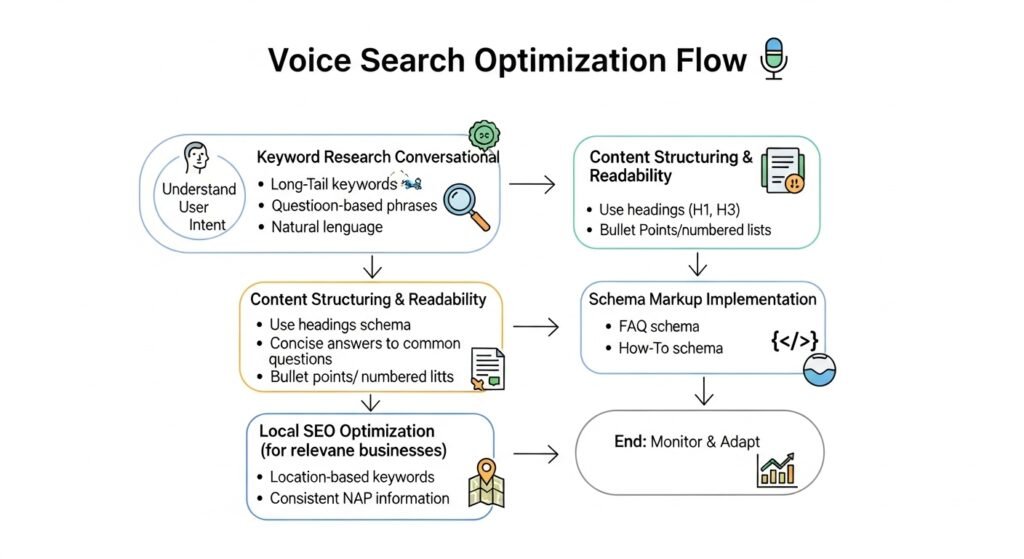
Successfully navigating the voice search landscape requires a strategic shift in your SEO approach. Here’s how to effectively optimize your content for conversational keywords.
Researching Conversational Keywords
Traditional keyword research tools might not fully capture the nuance of voice queries. To uncover relevant conversational keywords:
- Analyze “People Also Ask” Boxes: Google’s “People Also Ask” (PAA) section in SERPs is a goldmine for understanding common questions related to your topic.
- Review Customer FAQs: Your customer service logs, support forums, and existing FAQ pages are rich sources of real-world questions.
- Use Question-Based Keyword Tools: Tools like AnswerThePublic or dedicated voice search keyword tools can help identify common questions.
- Think from the User’s Perspective: Imagine you are speaking to a voice assistant. What would you ask about your product or service?
Structuring Content for Voice Search
Content needs to be easily digestible and directly answer questions. Consider these structural elements:
- FAQ Sections: Create dedicated sections that directly answer common questions using clear, concise language.
- Clear Headings and Subheadings: Use H2s and H3s that often pose questions or directly address aspects of a question. For example, instead of “Benefits,” use “What are the Benefits of X?”
- Concise Answers: Provide short, direct answers to questions in the first paragraph or sentence of a section. Aim for answers that are around 29 words, as this is often the sweet spot for voice assistant responses.
- Natural Language Flow: Write content that sounds natural when read aloud. Avoid jargon where possible.
Leveraging Schema Markup
Schema markup, or structured data, is vital for voice search optimization. It helps search engines understand the context and meaning of your content. Specifically, using schema types like Question and Answer, FAQPage, and HowTo can explicitly tell search engines that your content provides direct answers to common queries. This significantly boosts your chances of being selected for a featured snippet or a voice search response.
Focusing on Local SEO
A significant portion of voice searches has local intent, such as “restaurants near me” or “best plumber in [city].” Optimizing for local SEO is therefore paramount for voice search optimization. Ensure your Google My Business profile is complete and accurate, with consistent NAP (Name, Address, Phone number) information across all online directories. Encourage customer reviews, as social proof often influences voice assistant recommendations.
Measuring Success in Voice Search Optimization
Tracking the performance of your voice search efforts requires looking beyond traditional metrics. New indicators of success are emerging.
Key Metrics to Track
- Featured Snippet Wins: Monitor how often your content appears in Google’s Featured Snippets for target conversational keywords.
- Direct Answer Volume: While harder to track directly, an increase in organic traffic from long-tail, question-based queries can indicate success.
- Local Pack Rankings: For local businesses, track your visibility in the local pack and “near me” searches.
- Website Engagement: Even if a direct answer is given, users might visit your site for more details. Monitor bounce rate, time on page for voice-optimized content.
Tools for Analysis
While dedicated voice search analytics tools are still evolving, you can leverage existing platforms:
- Google Search Console: Use the “Performance” report to filter queries by questions (e.g., queries containing “how,” “what,” “where”).
- Google Analytics: Track user behavior on pages optimized for conversational keywords.
- Third-Party SEO Tools: Many advanced SEO tools now offer features to identify question-based queries and monitor featured snippet performance.
The Future of Search: Beyond the Screen
The trajectory of search is clear: it’s moving towards more intuitive, conversational interactions. As artificial intelligence and machine learning continue to advance, voice assistants will become even more sophisticated at understanding context, nuance, and user intent. This means that optimizing for conversational keywords is not just about today’s search landscape, but about preparing for a future where search is seamlessly integrated into every aspect of daily life, often without a screen in sight. Businesses that adapt early will gain a significant competitive advantage.
Conclusion: Embracing the Conversational Revolution
The rise of conversational keywords marks a pivotal moment in the history of SEO. It signals a shift from rigid keyword matching to understanding and serving genuine user intent expressed through natural language. By focusing on comprehensive content, question-based research, structured data, and local optimization, businesses can effectively position themselves to capture the growing audience of voice search users. Embracing this conversational revolution isn’t just about adapting to a new technology; it’s about connecting with users on a more human, intuitive level, ensuring your brand remains discoverable in the evolving world of search.