
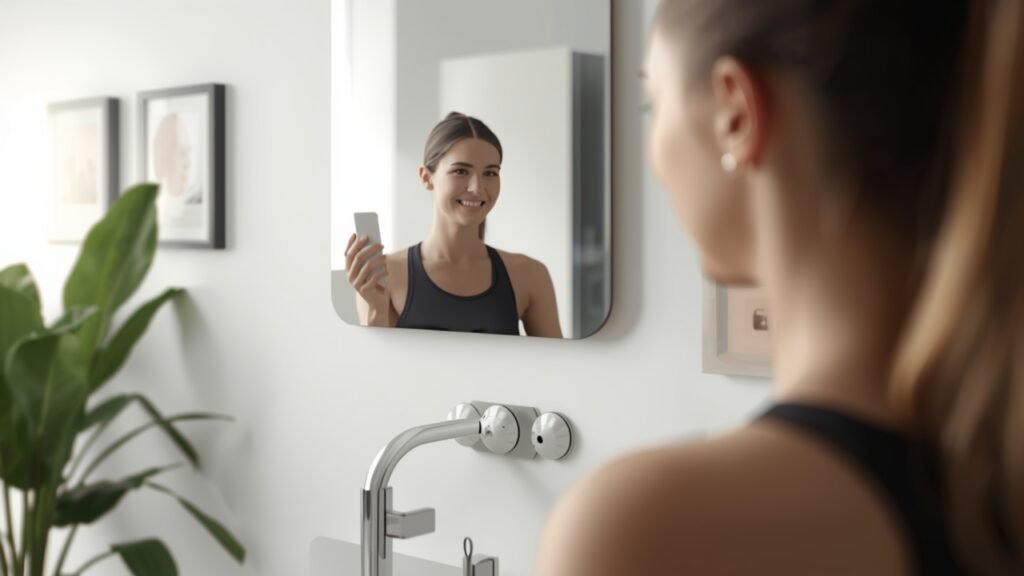
Imagine stepping in front of your mirror each morning, not just to check your reflection, but to greet a personalized fitness coach, track your progress, and manage your health goals – all with a simple voice command. This isn’t a scene from a sci-fi movie; it’s the reality of modern digital wellness, spearheaded by innovations like Voice-controlled smart mirrors with fitness tracking.
Table of Contents
For entrepreneurs, fitness professionals, and online businesses aiming to offer cutting-edge solutions, understanding the power of these Voice-controlled interactive fitness mirrors is becoming increasingly crucial. They represent a significant leap in how users engage with their fitness journeys, blending convenience, personalized data, and immersive experiences directly into their daily routines. This technology offers a unique opportunity to enhance user engagement, create new service models, and solidify a competitive edge in the rapidly evolving digital health market.
Tools & Requirements
Implementing or integrating a voice-controlled smart mirror solution for fitness tracking requires a blend of hardware, software, and API capabilities. For entrepreneurs and online businesses, the focus will often be on leveraging existing platforms and integrating custom content or services.
- Smart Mirror Hardware: Dedicated commercial smart mirrors (e.g., Fiture, Tonal, Echelon Reflect for integrated systems, or DIY kits for custom builds leveraging a two-way mirror, display, and mini-PC like Raspberry Pi).
- Voice AI Platform: Google Assistant API, Amazon Alexa Skills Kit, or Microsoft Azure Cognitive Services for custom voice command recognition and processing.
- Fitness Tracking APIs: Strava API, Apple HealthKit API, Google Fit API for syncing user fitness data from wearables and other applications.
- Cloud Computing Platform: AWS, Google Cloud, or Azure for backend data storage, processing, and application hosting. This is crucial for scalability and secure data management.
- Programming Languages & Frameworks: Python, JavaScript (Node.js), or C# for developing custom applications, integrating APIs, and building serverless functions.
- User Authentication & Data Security: OAuth 2.0, JWT, and robust encryption protocols to secure user profiles and sensitive health data.
- Content Management System (CMS): A flexible CMS (e.g., WordPress with custom plugins, Contentful, Strapi) to manage fitness routines, workout videos, and coaching content delivered through the mirror.
Setup & Implementation Timeline

The timeline for setting up and seeing results from a voice-controlled smart mirror integration can vary significantly based on the complexity and scope of your project. For a basic integration leveraging existing commercial mirrors with custom content, the learning curve is moderate (2-4 weeks) for developers familiar with APIs and cloud services. A comprehensive, custom-built solution, however, could entail a steeper learning curve (2-3 months) and a longer setup time (3-6 months or more).
Initial setup of core voice commands and basic fitness data integration might take 4-8 weeks. Testing and refinement, especially for nuanced voice interactions and data accuracy, could add another 2-4 weeks. Visible results, such as increased user engagement or initial data insights, can typically be observed within 3-6 months post-launch, as users adapt to the technology and provide feedback for optimization.
Step-by-Step Implementation Guide

Implementing a solution centered around Voice-controlled smart mirrors with fitness tracking requires a systematic approach. Here’s a guide for online businesses looking to integrate or offer such a service:
- Define Core Use Cases: Clearly identify what specific fitness services your smart mirror will offer. Examples include guided workouts, progress tracking, personalized coaching feedback, nutrition suggestions, or meditation sessions. This clarity guides subsequent technical decisions.
- Choose Your Platform & Hardware: Decide between building a custom mirror solution or integrating with an existing commercial smart mirror platform via their SDKs/APIs. For custom builds, select a mini-PC (e.g., Raspberry Pi 4), a display, and a two-way mirror.
- Integrate Voice AI: Set up your chosen voice AI platform (e.g., develop an Alexa skill, Google Assistant action, or use Azure’s Speech-to-Text and LUIS for custom intent recognition). Define a robust set of voice commands and responses for fitness activities (“start a yoga session,” “show my heart rate,” “log my water intake”).
- Develop Fitness Tracking Backend: Build a secure cloud-based backend to store user profiles, fitness data, and content. Integrate with third-party fitness APIs (Strava, Google Fit) to pull and push data from wearables and other health apps. This is where the fitness tracking component of your Voice-controlled interactive fitness mirrors truly shines.
- Content Creation & Delivery: Develop or license high-quality fitness content (workout videos, audio guides, text-based tips). Implement a system to deliver this content dynamically to the mirror’s display based on user profiles and voice commands.
- User Interface (UI) Development: Design a clean, intuitive, and distraction-free visual interface for the mirror. While voice is primary, visual feedback is essential for data display, video playback, and prompts. Optimize for legibility and simplicity.
- Testing & Iteration: Rigorously test all voice commands, fitness tracking accuracy, data synchronization, and content delivery. Gather user feedback to iterate and improve the experience, ensuring smooth and reliable operation.
Key Benefits & Business Impact
The adoption of Voice-controlled smart mirrors with fitness tracking offers profound benefits for entrepreneurs and online businesses, driving significant business impact. Firstly, it provides an unparalleled level of personalization and engagement, turning a passive fitness routine into an interactive experience. This leads to higher client retention rates for fitness coaches and online platforms, as users feel more connected and supported.
Secondly, the wealth of data collected—from workout performance to heart rate and calorie burn—empowers businesses to offer data-driven insights and hyper-personalized recommendations, creating premium service tiers and subscription models. This translates directly into increased ROI and diversified revenue streams.
Moreover, these mirrors enable significant scalability for fitness and wellness businesses. A single coach or platform can reach and guide numerous clients simultaneously through tailored digital content, overcoming geographical limitations. The automation of routine tasks, like tracking reps or suggesting next steps, frees up human coaches to focus on complex client needs and strategic development. The secure collection and analysis of fitness data also provide invaluable market insights, allowing businesses to adapt offerings and refine their target audience strategies, solidifying their position with Voice-controlled interactive fitness mirrors at the core.
Advanced Tips, Alternatives, or Optimization Strategies
To truly stand out, consider these advanced strategies:
- AI-Powered Personalization: Go beyond basic tracking by integrating machine learning algorithms to analyze user performance patterns, predict potential injuries, and dynamically adjust workout intensity or recovery recommendations in real-time.
- Gamification: Implement gamified elements such as achievement badges, leaderboards (optional, with privacy settings), and challenge modes to boost motivation and foster a sense of community.
- Augmented Reality (AR) Overlays: Utilize AR capabilities within the mirror to provide visual cues for form correction during exercises, display virtual overlays of anatomical diagrams, or even project virtual training partners.
- Integration with Wearables & IoT: Ensure seamless, multi-device integration with a wide range of smartwatches, heart rate monitors, smart scales, and other IoT fitness devices for a holistic data view.
- Subscription & Premium Content Models: Offer tiered subscription services for access to exclusive content, advanced analytics, one-on-one virtual coaching sessions, or specialized programs.
- Biometric Feedback: Explore advanced sensors for posture analysis, body composition tracking, or even stress level monitoring to offer a more comprehensive wellness solution.
Common Mistakes to Avoid
While the potential is vast, several pitfalls can hinder success:
- Overcomplicating Voice Commands: Users expect natural language. Avoid requiring overly specific or rigid phrases. Design for flexibility and provide clear prompts if a command isn’t understood.
- Neglecting Data Privacy & Security: Handling sensitive health data demands stringent security measures and clear privacy policies. A breach can severely damage trust and lead to regulatory issues. Always prioritize encryption and user consent.
- Inadequate Content Library: A smart mirror is only as good as the content it delivers. A limited or unengaging content library will quickly lead to user disinterest. Regularly update and diversify your fitness programs.
- Poor Voice Recognition Accuracy: Environmental factors (background noise) and diverse accents can affect voice recognition. Invest in robust voice AI and offer calibration options to ensure a smooth user experience.
- Lack of Third-Party Integrations: Users often have existing fitness apps and wearables. Failing to integrate with popular platforms creates data silos and diminishes the mirror’s utility as a central hub.
- Ignoring User Feedback: Launching without a feedback loop means missing critical insights into user pain points and feature requests. Implement clear channels for feedback and iterate based on user input.
Maintenance, Updates & Long-Term Optimization
Sustaining the value of your smart mirror solution requires ongoing commitment. Regular software updates are paramount, not only to introduce new features but critically to patch security vulnerabilities and improve performance. Establish an automated deployment pipeline for delivering these updates seamlessly to user devices.
Continuous monitoring of system performance, voice command recognition accuracy, and data synchronization is essential. Utilize cloud monitoring tools to track uptime, API response times, and error rates. Implement robust backup strategies for all user data and content to prevent loss. Regularly refresh your fitness content library with new workouts, challenges, and expert tips to keep users engaged and the platform feeling fresh. Engage with your user community to gather insights for long-term feature development and continuous improvement, ensuring your offering remains relevant and competitive.
Conclusion
The convergence of voice AI and smart display technology has ushered in a new era for personal wellness. Voice-controlled smart mirrors with fitness tracking are not just futuristic gadgets; they are powerful tools poised to redefine how individuals manage their health and fitness journeys.
For entrepreneurs, startups, and established online businesses, integrating or developing solutions around these devices presents an incredible opportunity to enhance customer engagement, generate rich data insights, and build scalable, impactful services. By focusing on robust implementation, user privacy, and continuous content innovation, you can leverage Voice-controlled interactive fitness mirrors to create truly immersive and personalized experiences that drive value and foster lasting customer loyalty. Now is the time to explore how this transformative technology can elevate your business in the digital health landscape.
FAQs
Q: Is a voice-controlled smart mirror suitable for all fitness levels?
A: Yes, most platforms are designed with scalability, offering a range of workouts from beginner to advanced. Users can often customize programs, ensuring they receive appropriate guidance and challenges tailored to their current capabilities and goals.
Q: How do these mirrors ensure data privacy?
A: Reputable smart mirror solutions employ strong encryption for data transmission and storage. They adhere to privacy regulations like GDPR or CCPA, requiring explicit user consent for data collection and offering clear options for data management and deletion.
Q: Can I integrate my existing fitness apps with a smart mirror?
A: Many commercial smart mirrors offer API integrations with popular fitness ecosystems such as Apple Health, Google Fit, or Strava. This allows for seamless data synchronization, providing a consolidated view of your overall wellness metrics.
Q: What are the primary cost considerations for implementing this technology?
A: Costs can range from the purchase of commercial hardware and subscription fees for content to significant investment in custom development, cloud infrastructure, and AI service usage for bespoke solutions. Content licensing is another key factor.
Q: How do smart mirrors provide feedback on workout form?
A: Advanced smart mirrors utilize built-in cameras and AI-driven computer vision to analyze body movements. They can compare your form against ideal demonstrations, providing real-time audio and visual cues for corrections, enhancing workout effectiveness and safety.