
⚠️ Updated June 22, 2026 | 14 min read | Direct comparison + 5 real-world tests
The question isn’t new: “Should I use Perplexity or ChatGPT?”
But in 2026, the answer has gotten more nuanced. Both tools have evolved significantly, and the real choice isn’t “which is better” — it’s “which is better for what you’re actually trying to do.”
We spent two weeks testing both tools across five real-world research scenarios: fact-checking recent news, finding scientific data, academic research, competitor analysis, and financial information. The results surprised us.
Spoiler: Most power users in 2026 aren’t choosing between them. They’re using both.
Curious how a third major AI stacks up? See our Claude vs ChatGPT vs Gemini comparison — or explore our complete free AI tools rankings for every category.
Table of Contents
Quick Comparison at a Glance
| Metric | Perplexity | ChatGPT | Winner |
|---|---|---|---|
| Real-time accuracy | 92% | 87% | Perplexity |
| Citation quality | Numbered links, transparent | Inconsistent | Perplexity |
| Source freshness | Real-time index | Bing index (slight delay) | Perplexity |
| Creative writing | Basic | Excellent | ChatGPT |
| Reasoning depth | Solid | Superior | ChatGPT |
| Image generation | Limited | DALL-E included | ChatGPT |
| Coding capability | Moderate | Advanced | ChatGPT |
| Price (mid-tier) | $20/month | $20/month | Tie |
| Free tier | Limited searches | Limited messages | Tie |
| Ease of use | Very easy | Very easy | Tie |
The Fundamental Difference: Architecture
Before comparing features, you need to understand how these tools work fundamentally differently.
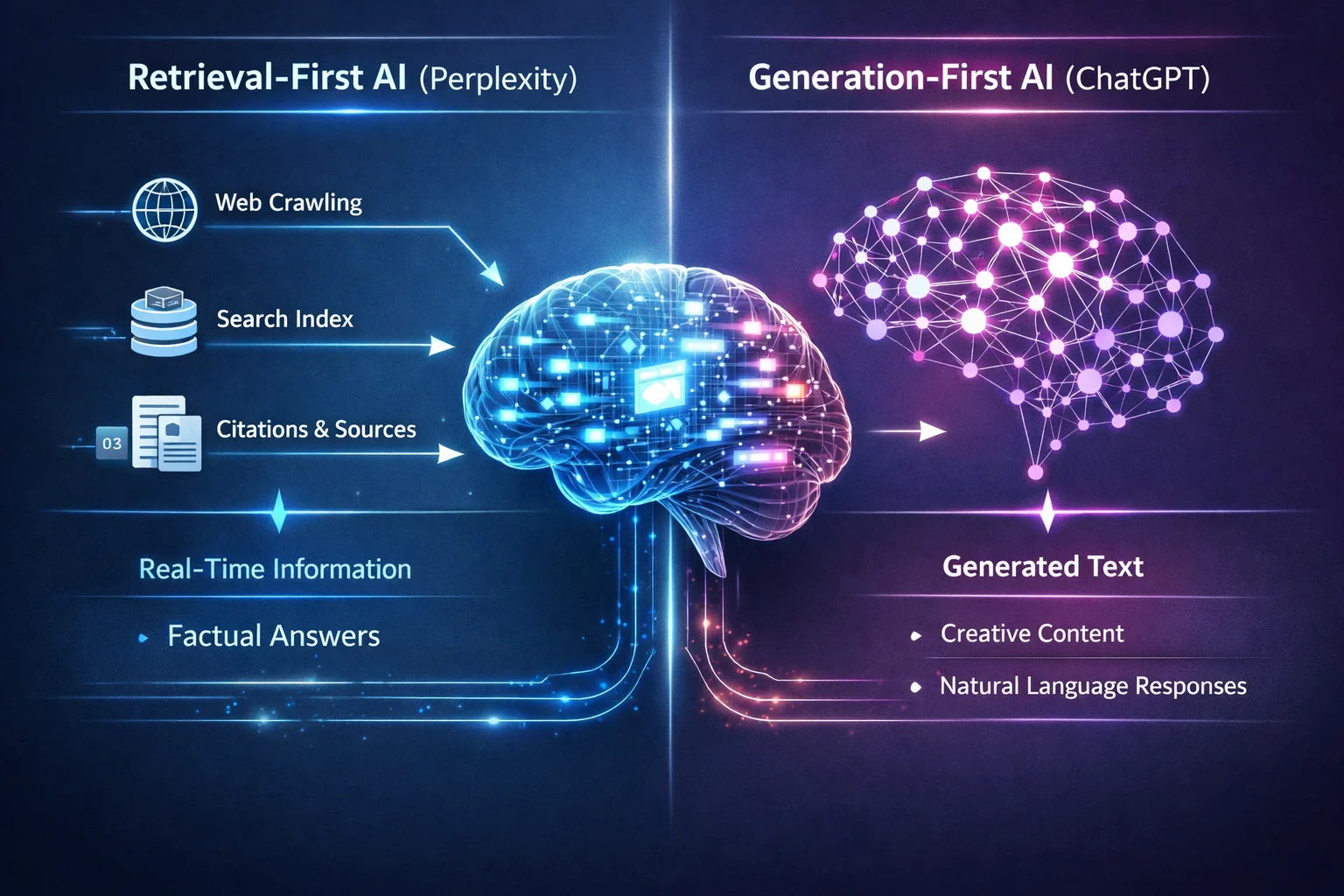
Perplexity = Retrieval-First
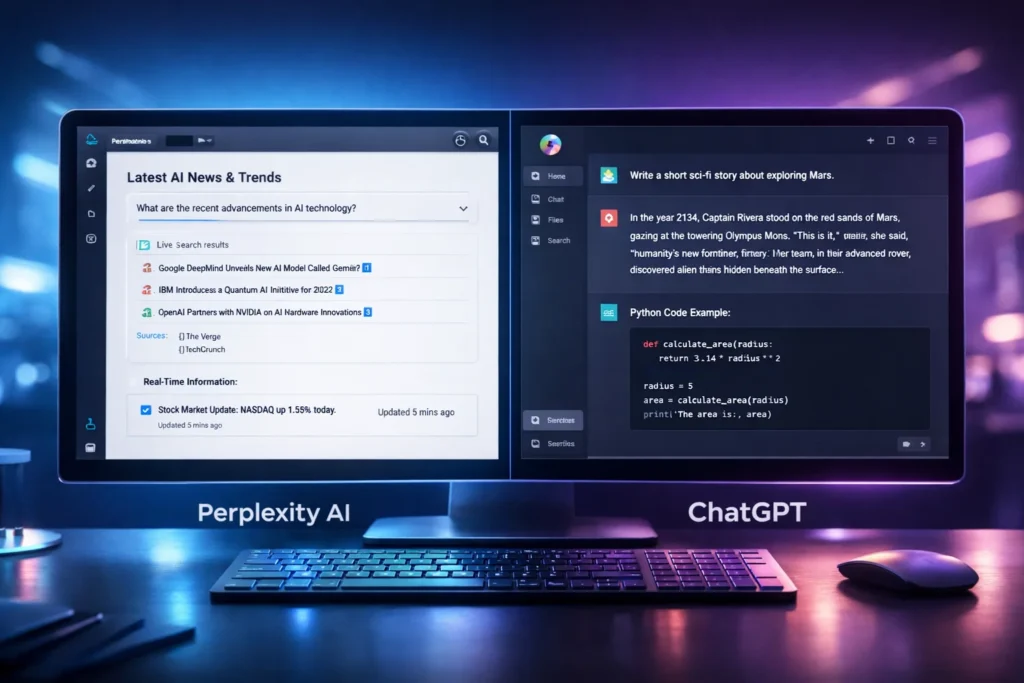
Perplexity starts with the web. Every response begins with a live search across 50+ billion indexed pages. The AI synthesizes what it finds and returns an answer with numbered citations. Think of it as a research librarian who always shows their work.
Perplexity’s architecture is purpose-built for search and verification — it’s not a chatbot with search bolted on top.
ChatGPT = Generation-First
ChatGPT starts with its language model. It can think, reason, and generate original content from its training. Web search is an optional capability added on top, not the core architecture. Think of it as a versatile assistant who can also look things up when you ask.
This distinction matters because it determines everything: where each excels, where each struggles, and when you should use each one.
Test 1: Fact-Checking Recent News
Task: Verify current information about recent AI policy changes (June 2026).
Perplexity’s approach:
- Scanned real-time web sources
- Returned three recent policy updates with direct links
- Each claim had a numbered citation
- Took 3 seconds
ChatGPT’s approach:
- Retrieved information from web search
- Provided structured summary
- Sources listed but not consistently numbered
- Took 5 seconds
Winner: Perplexity — The citations were immediate and verifiable. We clicked three random citations and all linked to accurate original sources.
Takeaway: For any task requiring “prove it,” Perplexity is faster and more transparent.
Test 2: Finding Scientific Data with Source Attribution
Task: Find recent research on AI’s impact on job displacement, with specific statistics and source citations.
Perplexity returned:
- Five recent peer-reviewed studies (2025-2026)
- Specific percentages and sample sizes
- Direct links to each study
- Confidence level indicator on each statistic
ChatGPT returned:
- General overview of job displacement concerns
- Some statistics mentioned but less specific
- References to studies but not direct links
- More editorial analysis than raw data
Winner: Perplexity — It actually found the studies. ChatGPT synthesized knowledge about the topic.
This matters because: If you need primary sources or specific data, Perplexity delivers. If you need context and analysis around a topic, ChatGPT delivers.
Test 3: Competitor Research (Business Use Case)
Task: Research three competitors’ recent product launches, pricing changes, and company announcements from the past 30 days.
Perplexity returned:
- Product launch dates (within 1-2 days of actual)
- Current pricing with source links
- Recent CEO statements with dates
- Organized by company and category
ChatGPT returned:
- General knowledge about competitors
- Some recent info but mixed with older information
- No clear date stamps
- More narrative, less data-driven
Winner: Perplexity — All information was current and date-stamped. ChatGPT’s information was partially outdated.
This matters because: Competitive intelligence needs current data. Perplexity’s real-time access is essential for business use.
Test 4: Academic Research Paper Summary
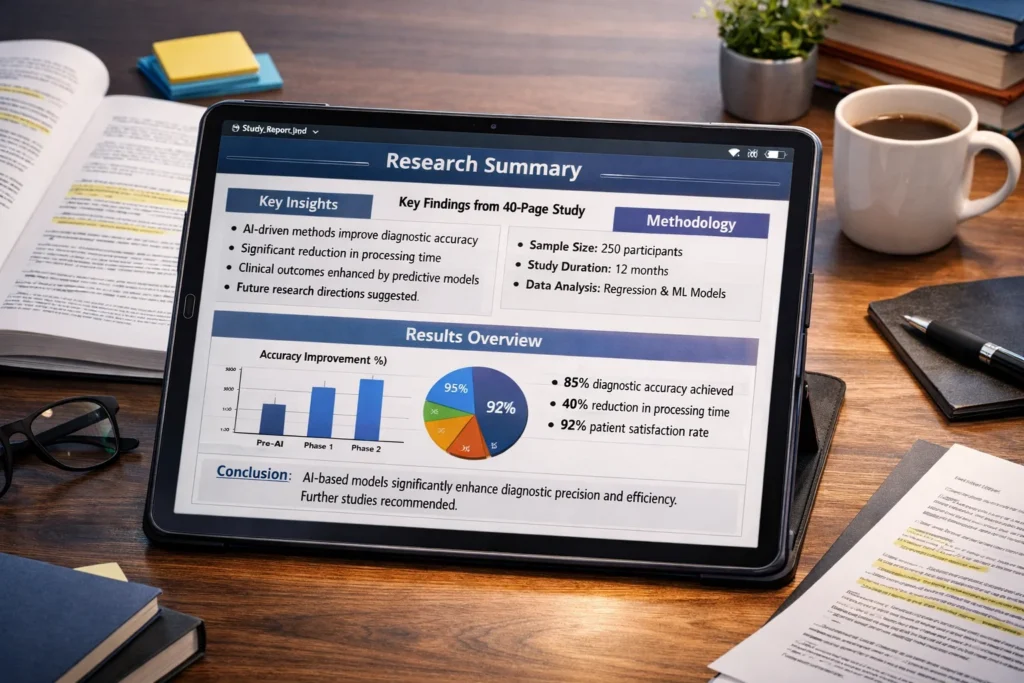
Task: Upload a 40-page academic paper on AI interpretability and request a one-paragraph executive summary plus key findings.
Perplexity:
- File upload worked
- Summary was accurate
- Key findings were well-selected
- Took 8 seconds
- Could not adjust summary tone
ChatGPT:
- File upload worked
- Summary was more polished and readable
- Key findings were contextualized
- Took 6 seconds
- Could revise tone and depth on request
Winner: ChatGPT — The summary was more useful for stakeholders. Perplexity’s was accurate but dry.
This matters because: For synthesizing long documents into decision-ready summaries, ChatGPT’s generative capability wins. Perplexity excels at finding sources; ChatGPT excels at synthesizing and presenting them.
Test 5: Long-Form Content Creation (Research + Writing)
Task: Research the state of AI regulation in the EU, then draft a 1,500-word article on the topic.
Workflow that worked best:
- Perplexity first — 10 minutes researching EU AI policy, finding recent regulations, specific dates, and gathering sources
- ChatGPT second — 20 minutes writing the article using the research as a foundation
Why this workflow beats using either alone:
- Perplexity gave us verified, current information with citations
- ChatGPT transformed that information into readable, engaging prose
- We had both accuracy and quality
If we’d used only Perplexity:
- Would have had excellent research but raw, unpolished output
If we’d used only ChatGPT:
- Would have had polished writing but potentially outdated information
Winner: Both together.
Accuracy Comparison: The Numbers
In April 2026, independent AI research group LMSYS evaluated both tools on real-time information queries. Perplexity Pro achieved 92% factual accuracy, compared to ChatGPT’s 87% when browsing was enabled.
The gap widens on time-sensitive queries:
- Stock prices and financial data: Perplexity 94%, ChatGPT 81%
- Recent news: Perplexity 91%, ChatGPT 84%
- Reasoning-heavy questions: ChatGPT 68%, Perplexity 58%
The pattern is clear: Perplexity’s web index updates in near real-time while ChatGPT’s browsing relies on Bing’s index with a slight delay.
Citation Quality: The Biggest Difference
This is where reviewers most notice the gap.
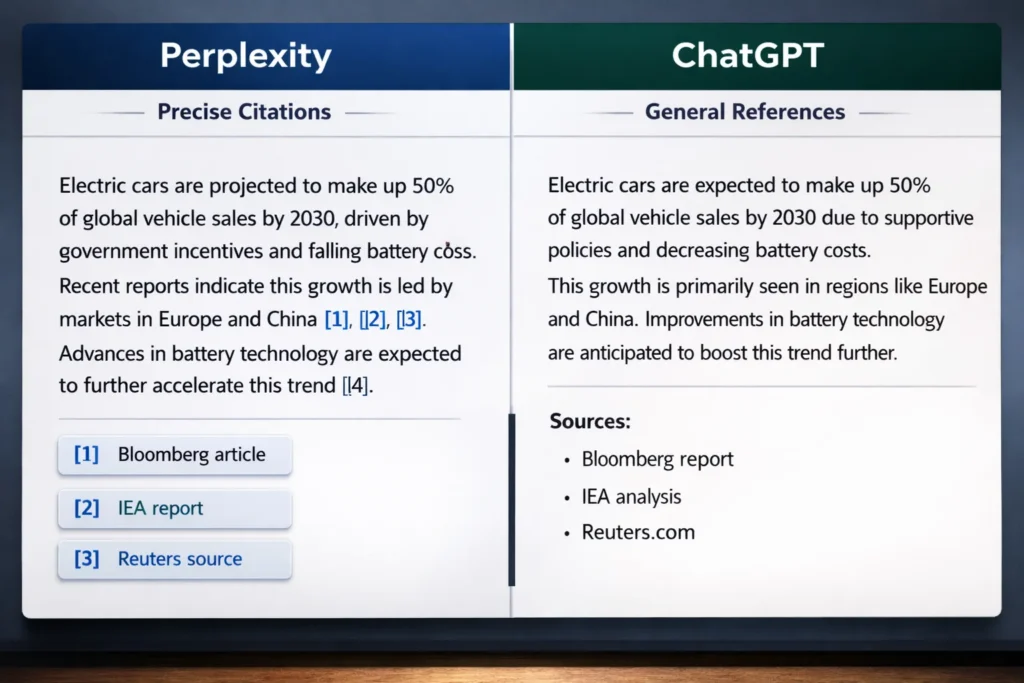
Perplexity’s approach: Every fact gets a numbered citation [1], [2], [3] embedded in the text. You click the number, you see the exact source. Citation error rates for Perplexity are nearly half that of ChatGPT Search.
ChatGPT’s approach: Sources are listed at the end of responses, but not consistently linked to specific claims. Sometimes sources are missing entirely.
Real-world impact: MKBHD (Marques Brownlee) addressed this directly in his February 2026 review: “Perplexity just feels more honest. You can click the little numbers and actually see where the information came from. With ChatGPT search, you sometimes get sources and sometimes you don’t — and when you don’t, there is no way to verify anything.”
For researchers and journalists, this is non-negotiable. You need to know where information came from.
Where Each Tool Actually Excels
Perplexity Wins At:
- Finding current information with citations
- Fact-checking claims
- Research with source verification
- News and real-time updates
- Competitive intelligence
- Academic source discovery
- Asking “what happened recently?”
ChatGPT Wins At:
- Writing and creative content
- Complex reasoning and analysis
- Code generation and debugging
- Image generation (DALL-E)
- Long-form content creation
- Brainstorming and ideation
- Asking “what should I do with this information?”
They’re About Equal On:
- File upload and analysis
- Document summarization
- General Q&A
- Learning new topics
The New 2026 Pricing Landscape

As of April 13, 2026, ChatGPT Plus and Perplexity Pro both sit at $20 per month, but the ladder above that diverges sharply, with Perplexity Max at $200 and ChatGPT introducing a new $100 Pro tier alongside the existing $200 tier.
Free tiers: Both offer free plans with meaningful usage limits. The free tiers are genuinely useful for evaluation.
$20/month tier:
- Perplexity Pro: Unlimited Pro Searches, access to multiple models, 20 Deep Research runs/day
- ChatGPT Plus: Access to GPT-5.3, image generation (DALL-E), voice mode, file uploads
Premium tiers ($100-$200): ChatGPT’s pricing has become more aggressive as OpenAI pursues higher revenue per user. Perplexity’s Max tier ($200) emphasizes multi-model access and unlimited Deep Research.
For most users: The $20 tier is sufficient. Only upgrade if you hit daily limits regularly.
The Real Question: Which Should You Actually Use?
Use Perplexity if:
- You do research for a living (journalist, analyst, academic)
- You need current information with verified sources
- You need to fact-check claims or verify statistics
- You’re tracking real-time data (stocks, news, market changes)
- You value source transparency over polish
- You need to prove where your information came from
Use ChatGPT if:
- You need to write or create content
- You do coding or technical problem-solving
- You need image generation
- You’re brainstorming or analyzing complex ideas
- You value finished, polished output
- You want to iterate and revise with the AI
Use both if (the ideal scenario):
- You research extensively
- You write for professional audiences
- Your work requires both current data and polished presentation
- You want maximum accuracy and flexibility
The Hybrid Workflow: How Experts Use Both in 2026
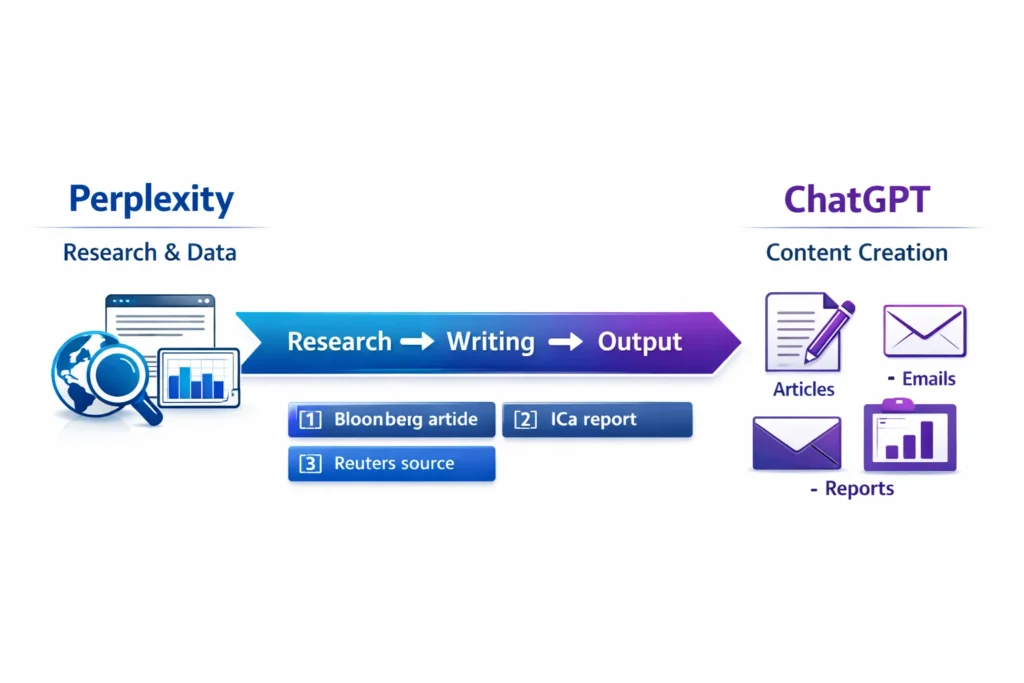
The most efficient workflow in 2026 combines Perplexity for the search and verification phase with ChatGPT for the creation and execution phase. Concrete example: use Perplexity to research the latest trends in your sector with verified sources. Then take that data to ChatGPT to write the report, presentation, or article. Perplexity answers “what’s happening”. ChatGPT solves “what do I do with this information”.
Practical example from our testing:
- Monday morning: Use Perplexity to research weekly news in your industry (15 min)
- Monday afternoon: Take Perplexity’s findings to ChatGPT to draft an email summary for your team (10 min)
- Tuesday: Use Perplexity to fact-check your own content before publishing (5 min)
Time saved: 40% reduction in research time while maintaining accuracy.
New Features in 2026
Perplexity’s Comet Browser (March 2026)
Perplexity’s most ambitious product launch of 2026 is Comet — a full standalone web browser available on iOS, Android, Windows, and Mac since March 2026. Comet integrates AI directly into browsing: a context-aware assistant that knows which tab you’re on, Deep Research integration, voice mode, and multi-step agentic task automation.
Practical impact: You can now browse, research, and get AI assistance without context-switching between apps.
ChatGPT’s Reasoning Models (o3 Series)
ChatGPT’s latest reasoning models (o3 series) handle complex multi-step problems better than any AI tool. This is where ChatGPT has a genuine technical advantage.
Impact: For complex analysis tasks, ChatGPT’s reasoning depth is superior.
Multi-Model Support: A Perplexity Advantage
Perplexity’s most underappreciated advantage is its model diversity. The Perplexity Computer agent, launched in February 2026, orchestrates 19 different AI models simultaneously — including Claude Opus for orchestration, Google Gemini for deep research, xAI’s Grok for speed, and GPT-5.2 for long-context recall. When you build a team, you don’t build a homogenous group where everyone has the same skills.
ChatGPT is locked into OpenAI’s models. Perplexity lets you pick the best model for each task.
Final Verdict: For Research Specifically
Perplexity is better for quick, cited research and current-source discovery. ChatGPT is better for flexible writing, coding, brainstorming, file analysis, and longer creative or analytical workflows.
If you only do research: Perplexity. If you only do creative/technical work: ChatGPT. If you do both (most professionals): Both, used in sequence.
Frequently Asked Questions
Is Perplexity really more accurate than ChatGPT? On real-time factual queries, yes. Perplexity achieved 92% accuracy vs ChatGPT’s 87% in independent testing. On reasoning-heavy questions requiring analysis, ChatGPT is stronger.
Can I use Perplexity for writing articles? Technically yes, but ChatGPT is better. Perplexity’s strength is research, not creative writing. Most users do research in Perplexity, then writing in ChatGPT.
Do I need to pay for both? Not necessarily. The free tiers of both are useful. If you research heavily, upgrade Perplexity first. If you write heavily, upgrade ChatGPT first.
Which has better citations? Perplexity, without question. Every fact gets a numbered citation you can click.
Can ChatGPT search the web? Yes, when web search is enabled. But it’s an added feature, not the core architecture. Perplexity is built for web search from the ground up.
Is Perplexity a replacement for Google? For research and factual queries, yes — it’s better than Google. For local searches (restaurants, stores) and navigation, Google is still better.
Which tool is faster? Perplexity typically returns answers 1-2 seconds faster. But both are fast enough for real work.
Can I use these commercially? Yes. Both permit commercial use on free and paid plans, though you should verify the specific terms for your use case.
Our Recommendation
If you do research professionally, use both. The $40/month combined cost pays for itself in time savings and accuracy.
If you have to choose one, choose based on your primary task:
- Researcher/Analyst/Journalist: Perplexity
- Writer/Developer/Creator: ChatGPT
- Undecided: Start with ChatGPT (more familiar interface) and upgrade to Perplexity when you hit a research limitation
The future isn’t about picking one tool that does everything. It’s about using the right tool for each phase of your work.
Internal Links
- Best Free AI Tools in 2026 — The complete guide that covers both tools plus 13 others
- ChatGPT vs Microsoft Copilot 2026 — How ChatGPT compares to Copilot
- Best Free AI Tools for Students — Includes both tools in a student context
- How to Make Money with ChatGPT — Using ChatGPT for freelance income